Duel:Arena 1 results
Brandon Jenkins stopped Mike Perry at 2:38 of round one, in a fight that was not on the poster, on a pay-per-view that stopped being a pay-per-view a few hours before it started. The full card, every result we can stand behind, and the video.
STOPPAGE
THE CARD
What happened
Duel:Arena 1 ran on Saturday 29 August 2026 at the Kia Center in Orlando — the debut card from the combat sports promotion launched by the operator behind Duel. Almost nothing about it finished the way it was sold. The advertised main event never took place. Its replacement lasted less than a round and ended on an injury. The pay-per-view was given away free. And the promotion spent fight week generating more coverage for its social media conduct than for its matchmaking.
What follows is the card as it actually happened, with what is confirmed kept carefully separate from what is not.
Main event: Jenkins stops Perry inside a round
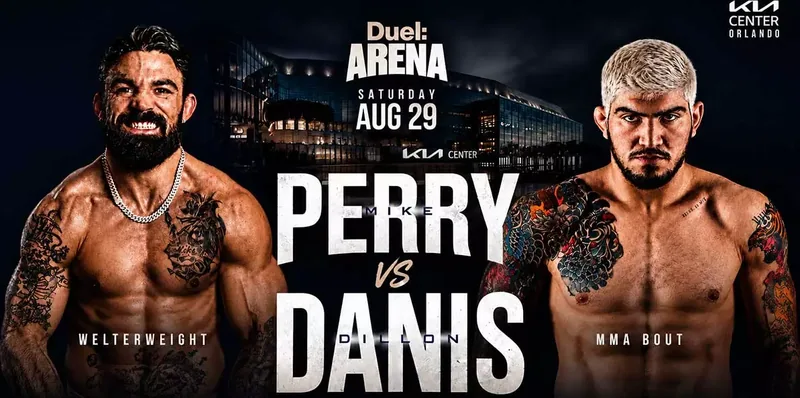
The fight everyone bought a ticket for was Mike Perry against Dillon Danis. It did not happen. Danis withdrew injured late on Thursday 27 August, two days out. Rather than lose the headliner entirely, the promotion signed Brandon Jenkins — a UFC, PFL and LFA veteran with a 17-11 record and ten knockouts — on roughly 48 hours’ notice. Jenkins was in Las Vegas when the call came.
The bout was reworked around him. It had been announced at 170 lb welterweight for Danis; post-event results list the Jenkins version at middleweight, contested over three five-minute rounds under MMA rules, in a ring.
Perry started the way Perry always starts: forward, heavy, happy to make it ugly early. Then something went wrong. A couple of minutes in he appeared to hurt his shoulder, and it is visible in the footage — he backs toward the ropes with his right arm tucked against his ribs and stops throwing it. Jenkins, a heavy betting underdog, read it immediately and stepped on the gas. The finish was a kick to the body, and the referee waved it off at 2:38 of round one.
Two things are worth keeping apart, because social media blurred them within the hour. The official result is a technical knockout and the listed finishing strike is a body kick. Separately, trade reporting describes Perry dislocating the shoulder partway through the round, and the video is consistent with an arm that stopped working before the finish. What has not happened is any formal confirmation: no medical report has been published and neither Perry nor his team has issued one, so the specific diagnosis is what reporters were told and saw rather than something on the record.
For Perry it is a first MMA loss since April 2021, and a sour end to a run that included stopping Nate Diaz earlier in the year. For Jenkins it is a second straight win and exactly the kind of short-notice upset that pays for itself in future bookings.
The purse cut
One detail from fight week deserves more attention than it got. After Danis pulled out, Perry accepted a replacement opponent who was, on any reasonable read, more dangerous than the one he had trained for — a working professional with ten knockouts rather than a grappler who had barely competed in years. Reporting from Uncrowned’s Ariel Helwani during fight week said Perry was handed a 50% purse cut for taking that fight.
That is worth stating plainly on a page that also carries an affiliate link to the operator behind the promotion. A fighter took a harder fight on two days’ notice, for half the money, and lost it on an injury. However the marketing is framed afterwards, that is what the debut card cost the man on the poster.
| Bout | Discipline | Result |
|---|---|---|
| Brandon Jenkins def. Mike Perry | MMA · main event | TKO (body kick) — 2:38, R1 |
| Paul Miller def. Ben Azoulay | Kickboxing · heavyweight | Split decision (28-29, 30-27, 30-27) |
| Jimi Manuwa def. Chase Sherman | Boxing · heavyweight | TKO (punches) — 1:52, R2 |
| Blake Anthony def. Nate Morrow | MMA · 145 lb | Unanimous decision (30-27, 29-28, 30-27) |
| Alex Nicholson def. Brad Taylor | MMA · heavyweight | TKO (punches) — 2:47, R1 |
| Ryan Pownall def. Patrick Clark Jr. | Boxing · 200 lb | Disqualification (shoving) — 2:00, R2 |
| Phil Rowe def. Javanis Ross | Boxing · 175 lb | Unanimous decision (39-27, 40-36, 40-36) |
| Jack Grady vs Wade Stokan | Boxing · 165 lb | Grady listed as winner — unofficial |
| A.J. Cunningham vs Joe Penafiel | MMA · 155 lb (prelim) | Cunningham listed as winner — unofficial |
| Thomas Phillips vs Shane King | Boxing · 120 lb (prelim) | Phillips listed as winner — unofficial |
| Daniel Cao vs Mason Ajester | Boxing · 165 lb (prelim) | No published result |
The seven bouts at the top are confirmed against published post-event reporting. The three marked unofficial are winners listed in fight databases that carry their own accuracy disclaimer, and did not appear in any official post-event release we could find. The last has no published result at all. We would rather leave a gap than invent a winner — this page gets updated, not padded.
How the week fell apart
A first-time promotion losing its headline act 48 hours before doors is close to the worst case. Duel:Arena’s answer was to lean into the chaos rather than apologise for it, and that is where the event picked up most of its mainstream coverage.
The promotion’s official social accounts spent the build-up attacking Danis personally, including a post using a homophobic slur that drew wide criticism. They also brought a member of his family into the event in a ring-card role and posted images of her to needle him. We are not reproducing any of that here, and we are not publishing the footage of that segment.
Our position needs no nuance: we report the fights. The promotional conduct around this card is documented by outlets whose job that is, and readers can judge it for themselves without us farming clicks off the language used.
The co-feature, and what it was sold as
The kickboxing bout described above as the co-feature needs a fuller account, because the sporting result is the least significant thing about it.
Paul Miller, who competes as “Gypsy Crusader”, is a documented far-right internet personality. He built his following on video-chat platforms by appearing in a Joker costume and broadcasting white supremacist, antisemitic and racist harassment at strangers. He was arrested by the FBI in March 2021 and sentenced that September to 41 months in federal prison after pleading guilty to federal firearms charges as a convicted felon, and was released in January 2023. He has publicly called for a race-based civil war. None of this is contested background or an accusation from opponents; it is the documented record, and it is the reason his name carries an audience at all.
Ben Azoulay is Jewish, and the matchup was not built in spite of that. After the decision, an account presenting itself as an official Duel representative — its bio describes the holder as the company’s scribe and herald — posted a message framing the bout in explicitly antisemitic terms as a contest between an anti-Jewish fighter and a Jewish one, and congratulating Miller on the outcome. That is the promotion describing its own product, not an anonymous reply-guy.
During the event Miller was filmed performing Nazi-style salutes, and a member of his corner wore a shirt carrying an anti-Israel slogan directed at his opponent. Both were widely reported and the footage circulated broadly.
A swastika flag inside the Kia Center
Separately from anything either fighter did, video shot inside the arena — filmed by Patrick Clark Jr., who boxed on the undercard — shows spectators raising a Nazi flag in the stands during the show. Clark, a former WWE performer, has since described it on the record: he said he saw the flag with a large swastika, filmed it himself, and that after the co-feature the winning fighter and his cornermen gave Nazi salutes to the crowd. He said he had lived in Orlando for six years and had never seen anything like it.
The Kia Center is owned and operated by the City of Orlando, and its own rules prohibit signage carrying derogatory imagery or political statements. Footage shows the man with the flag was eventually confronted by venue staff and escorted out, though how long that took is not clear. A spokesperson for Orlando Venues, the city department that runs the building, told Orlando Weekly that the city does not condone the messaging shown during the event and that the flag was removed once staff saw it, while noting the city cannot make booking decisions based on the content of an event.
By the start of the week the story had moved well past the trade press into Orlando television and citywide news, and the political reaction crossed party lines: a Democratic state representative currently running for Orlando mayor called the incident disgusting and a reminder of how prevalent extremism has become, and Florida’s Republican senator called it utterly disgusting and said antisemitism has no place in the state. Trade coverage of the card called for condemnation from the promoters, the commission, the sponsors and the fighters involved.
The event was hosted by Duel:Arena and promoted by Gamebred Bare Knuckle MMA. Neither responded to requests for comment from the outlets that covered it, and one Orlando newsroom reported being unable to reach anyone representing the promotion at all.
This happened at a state-sanctioned athletic event, in a publicly owned arena, in 2026. We are not republishing that footage and we are not linking it. It is on the record with the outlets that covered it, and it belongs in any honest account of what Duel:Arena 1 was.
What happened in the crowd
The most-watched footage from the night did not come from the ring. Once the decision was read, a brawl broke out between Miller’s entourage and people in the seating bowl. Reporting describes his ringside group spending the evening goading Azoulay and other spectators, his crew repeatedly engaging with the crowd afterwards, punches and kicks thrown by multiple people, at least one man visibly bleeding, and the disturbance continuing backstage.
Sedriques Dumas, attending as a spectator, was filmed taking down a costumed fan aligned with Miller before security separated them. Dumas (10-5) is a former UFC fighter, not a current one: he was released by the promotion in July, shortly after being sentenced on charges arising from an arrest in Escambia County, Florida, on home invasion, battery and possession of a weapon by a convicted felon.
Days later the promotion announced its first spectator ban. It did so in a post that mocked Dumas’s name — which is consistent with how its official accounts behaved all week rather than a departure from it.
The promotion’s own accounts
The conduct of Duel:Arena’s official channels is not a side story to this card; by the weekend it had become the main one. Over roughly ten days the same accounts published a post using a homophobic slur about Dillon Danis during the build-up, brought a member of his family into the show in a ring-card role and posted images of her to needle him, and then, after the disqualification, published a post about Patrick Clark Jr. containing an overtly racist slur — framed, remarkably, as an apology for having platformed him.
One of the event’s own commentators apologised to viewers afterwards and described it as the worst event he had ever worked. When the broadcast team is issuing apologies for the show they were paid to call, the problem is not a run of bad luck with matchmaking.
Where that leaves this page
We report the fights. We are not reproducing the slurs, the salutes or the flag, and we have not published the footage of any of them. All of it is documented by outlets whose job that is, and readers who want the detail can find it without this page monetising it.
But a results page that left it out entirely would be describing a different event than the one that took place, and the honest summary is this: the sporting content of Duel:Arena 1 was a short main event ended by injury and a handful of competent undercard bouts, and the thing the card will actually be remembered for is the rest of it.
One distinction is worth keeping, in both directions. A fight promotion is not the same product as a casino, and nothing described here changes how a deposit, a withdrawal or a rakeback calculation works. But the two share a brand, a founder and — in the case of the post about the co-feature — personnel. Readers can weigh that themselves; pretending the two are unconnected would be as misleading as pretending they are the same thing.
The pay-per-view that stopped being one
Duel:Arena 1 was announced and sold as a pay-per-view at around thirty dollars, ordered through the promotion’s own platform, with the prelims free on YouTube from 6:00 pm ET and the main card behind the paywall from 8:00 pm ET.
Then, hours before the first bell, the promotion put the entire card on YouTube for nothing. For a debut promotion trying to build an audience that is a defensible call — reach now, monetise later — and a card that has just lost its main event is a hard sell at thirty dollars anyway. For anyone who had already paid, it was a strange evening.
It also needs saying, because the search results that week were full of it: every “Duel:Arena stream key”, “VIP unlock code” and “fight-night deposit bonus” being sold on Telegram and on scraped websites was a scam. There was no code. The stream was free and public.
Co-feature: Miller edges Azoulay on a split card
The heavyweight kickboxing co-feature between Paul Miller and Ben Azoulay went the full three rounds and came back a split decision for Miller: 28-29, 30-27, 30-27. Two judges gave Miller every round; the third gave every round to Azoulay. That spread is not the signature of a razor-thin fight so much as of three officials scoring on visibly different criteria, which is a recurring problem on cards that mix rule sets and experience levels.
This was the bout that pulled the crossover audience to the show, and it delivered what that lane usually delivers: volume, ragged technique, a heated post-fight interview and a result people argued about immediately. Miller competes under a streaming alias with a history that has attracted serious controversy; we are not amplifying the alias here, and the background is widely documented elsewhere.
The rest of the card
Jimi Manuwa against Chase Sherman — two UFC veterans in a heavyweight boxing match, which is exactly the kind of matchmaking this promotion is built on. Manuwa got the stoppage on punches at 1:52 of round two.
Alex Nicholson against Brad Taylor — heavyweight MMA, finished inside a round. Nicholson landed the cleaner shots and it was waved off at 2:47.
Ryan Pownall against Patrick Clark Jr. — the strangest ending on the card. The bout was stopped at 2:00 of round two and awarded to Pownall by disqualification for shoving. Disqualifications are rare enough anywhere that this one has taken on a life of its own in clips.
Blake Anthony against Nate Morrow went the distance at 145 lb, Anthony taking a unanimous decision. Phil Rowe against Javanis Ross also went to the cards, Rowe winning on scores of 39-27, 40-36, 40-36 — a shutout with knockdowns on one card.
Below that, the record gets thin. Three prelim bouts have winners listed in fight databases but no official post-event confirmation we could find, and one has no published result anywhere. That is not unusual for a debut promotion with no media operation behind it, but it is the reason the table above marks them rather than presenting them as settled.
The entertainment segments
Alongside the professional bouts the card carried costumed entertainment segments, staged in the same ring with the same broadcast graphics and round clock as the sanctioned fights. They are not part of the competitive record and are not counted in the results table above, but they are a large part of what the event actually looked like on the night, and pretending otherwise would misrepresent the show.
It is a deliberate blend. A card that opens with professionals and closes with a mascot in gloves is telling you exactly what it is: a broadcast product first and a sporting event second. Whether that is a problem depends entirely on what you turned up for.
A ring, not a cage
Every bout on the card, MMA included, took place in a boxing-style ring. That is not a cosmetic choice and it showed. Ropes behave nothing like a fence: a fighter can be pushed through them, there are four corners rather than a continuous wall, and the referee has a genuine safety problem to manage that a cage removes. Fighters who build their game around cage pressure lose one of their main tools.
It also changes the viewing experience, mostly for the better. Sightlines are cleaner from everywhere because there is no fence to look through, which is the single biggest complaint about watching MMA live. The trade is that ring posts obstruct from the corners, so elevated seating is worth paying for and corner-level seating is not.
The card was matched by Dean Toole, a long-standing MMA matchmaker rather than a marketing hire, and the professional bouts reflected that. The format built around them did not always.
In the building
The Kia Center is Orlando’s main downtown arena, the building the Magic play in, and a combat configuration puts a ring on the floor with the seating map rebuilt around it. Atmosphere at a debut show is never a controlled variable, and this one ran hot: walkouts pushed through the floor crowd, a bowl that filled unevenly, and the general looseness of a promotion running its first night.
Betting the card, in hindsight
The obvious question before the event was whether you could sensibly bet a card like this at the sportsbook run by the company promoting it. The night answered it.
A main event where one fighter was replaced 48 hours out, by a man flown in from another state, in a rule set neither had contested recently, decided by an injury inside a round — there is no model that prices that. The favourite lost to a heavy underdog because of something no handicapper can see coming. Elsewhere on the card a bout was decided by disqualification for shoving, and a three-round kickboxing match produced two 30-27 cards and one 29-28 the other way.
That is not a knock on the show; it is what crossover cards are. It is a reason to treat markets on them as entertainment rather than as an edge. How sports wagers work at the operator, including the way rakeback applies against the book margin, is on the sportsbook page, and the arithmetic of the margin itself is on the rakeback page. Neither changes the fact that this particular card was close to unmodelable.
What Duel:Arena 1 means for the brand
Duel has always grown on spectacle rather than advertising, because the advertising channels are closed to it. Google restricts gambling ads, Meta restricts them, most sports media will not take the money. So the strategy has been to manufacture coverage instead: celebrity sessions at the live blackjack table, the founder speaking directly to camera, clips engineered to travel. The videos page collects the results of that.
Arena is the same instinct at arena scale, and judged purely as an attention exercise it worked — the event out-trended shows with far larger budgets, mostly on the strength of things going wrong. Judged as a fight card it was thinner: a main event ended by injury inside a round, a co-feature settled on a split card, a disqualification, and a prelim record still incomplete two days later.
None of it changes anything about the gambling product, and that is worth saying plainly because the marketing deliberately blurs the two. No bonus was tied to the event, no casino account was needed to watch, and nothing in the cashier changed on fight night. If you came here for the operator rather than the fight, the review and the RTP breakdown are the pages that matter, and they would read the same if Arena had never happened. A well-marketed casino is still a casino, and a fight promotion is a marketing expense however good the main event turns out to be.
Is there a Duel:Arena 2?
Not yet, and nothing has been announced. The promotion has consistently framed Arena as a recurring series rather than a one-night stunt, and said so from the announcement onward, but as of this update there is no date, no venue and no card for a second event. Fight databases list the promotion as having held exactly one event, with no upcoming dates.
Anything claiming otherwise, particularly with ticket links attached, is ahead of the facts. What is worth watching is whether a second card exists at all and what it looks like. A follow-up with the same mix of professionals and internet names would suggest a real promotion. A long gap and a smaller venue would suggest the first card was a marketing expense that got written off.