Duel7 Plinko
A ball falls through a triangle of pegs into a multiplier slot. Nine configurations, all returning exactly what you stake in expectation, and none of them better than another.
| Rows | Risk | Top multiplier | Centre multiplier | Centre hit chance |
|---|---|---|---|---|
| 8 | Low | 5.6× | 0.5× | 27.3% |
| 8 | Medium | 13× | 0.3× | 27.3% |
| 8 | High | 29× | 0.2× | 27.3% |
| 12 | Low | 10× | 0.5× | 22.6% |
| 12 | Medium | 33× | 0.3× | 22.6% |
| 12 | High | 170× | 0.2× | 22.6% |
| 16 | Low | 16× | 0.5× | 19.6% |
| 16 | Medium | 110× | 0.3× | 19.6% |
| 16 | High | 1000× | 0.2× | 19.6% |
Top multiplier is the outermost slot; centre is where most balls land. Figures are indicative — check the paytable in the game, which is authoritative.
How it actually works
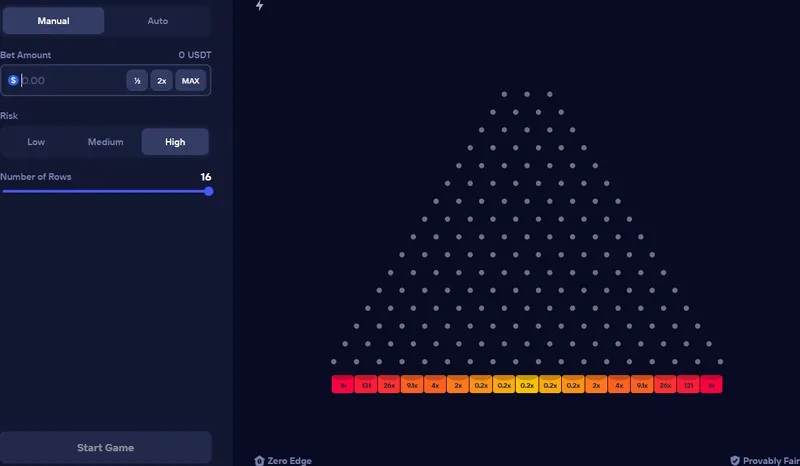
You choose a row count and a risk level, then drop a ball. It bounces left or right at each peg and lands in one of the slots along the bottom, each carrying a multiplier. Outer slots pay large, the centre pays less than your stake, and most balls land near the centre.
The bounce you watch is not happening. The landing slot is determined by the provably fair seeds before the animation begins, and the physics is a rendering of a result already fixed. This is worth knowing because it removes any temptation to read the path — there is nothing in it to read.
Why the settings do not matter
Every configuration in the table returns 100%. Sixteen rows on high risk offers a thousand times your stake and pays 0.2× on the overwhelming majority of drops. Eight rows on low risk tops out at 5.6× and returns something close to your stake most of the time. Both average out to exactly what you put in.
That is the same principle as the Crash payout curve: at zero house edge, higher potential is always paid for with lower frequency in exact proportion. There is no setting that beats another, and advice claiming otherwise is describing a preference about variance.
What the settings genuinely control is session length. Low risk on eight rows will keep a small bankroll alive for hundreds of drops. High risk on sixteen will burn through it while you wait for an outer slot that lands roughly once in several hundred attempts.
The distribution, briefly
Plinko is a binomial distribution rendered as a physical object. Each peg is a coin flip, and the number of right-versus-left bounces determines the landing slot. With sixteen rows there are sixteen flips, and the most likely outcome is eight of each — the centre.
The outer slots require every bounce to go the same way. On sixteen rows that is one path out of 65,536, which is why the multiplier there can be a thousand times the stake and the game still returns exactly 100%.
This also explains why the centre multiplier is below 1.0 at every setting. Most drops land there, so the game has to pay less than the stake in the common case to fund the rare enormous one. On a game with a house edge, the centre would pay slightly less still — that gap is where the operator earns, and here it does not exist.
Where Plinko came from
The game is borrowed wholesale from a television format, which is most of why it works: the mechanic needs no explanation and the anticipation is built into the physics. Crypto casinos adopted it early and it is now as standard as Crash.
The adaptation changed one thing fundamentally. On television the board is real and the bounce genuinely determines the outcome. Here the outcome is determined first, from the seeds, and the bounce is drawn to match. That is not a criticism — it is what makes the result verifiable — but it does mean the tension you feel watching a ball fall is entirely manufactured.
Worth holding onto, because the animation is doing a job. A number appearing instantly would feel like what it is. A ball taking two seconds to fall feels like a process with a chance in it, and that difference is why the game is designed this way at every operator that offers it.
Compared with Plinko elsewhere
Most implementations across the market run at around 99% RTP, applied by trimming every multiplier in the paytable by roughly a percent. It is invisible unless you compare paytables across operators, and almost nobody does.
Duel's runs at 100%, which means the multipliers on this page are the untrimmed ones. On a single evening the difference is noise. Across a few thousand drops — which auto-drop reaches quickly — it is the entire gap between a game that slowly drains and one that does not.
This is the same pattern across all five Originals, and it is funded by the slot catalogue and sportsbook where rakeback narrows an edge rather than removing it. The Originals are the reason to open the site; the rest is where the business earns.
Practical notes
Three habits that make a difference to how long a bankroll lasts, none of which change what it returns.
Auto-drop is where bankrolls disappear. Running hundreds of drops unattended at high risk compresses a long session into a few minutes. Expected return is unchanged; the speed at which variance resolves is not.
There is no hot or cold slot. Each drop draws independently. A run of centre landings makes an outer landing no more likely on the next drop.
Match risk to units, not to mood. If your bankroll is fifty drops, high risk on sixteen rows will almost certainly return nothing at all. The reciprocal of your realistic hit rate should fit inside your bankroll several times over.
Manual drops teach you more than auto. Watching fifty drops individually gives you an accurate feel for how rarely the outer slots land — which is the single fact most likely to stop you choosing high risk with a small bankroll. Auto-drop hides that behind a moving balance.
Full verification mechanics are on the provably fair page, and category figures are on the RTP table.