Duel7 Dice
Set a threshold, bet on rolling above or below it, and the payout adjusts to match. The simplest game on the site and the clearest demonstration of what zero house edge means.
| Win chance | Payout |
|---|---|
| 95.00% | 1.0526× |
| 75.00% | 1.3333× |
| 50.00% | 2.0000× |
| 33.00% | 3.0303× |
| 20.00% | 5.0000× |
| 10.00% | 10.000× |
| 5.000% | 20.000× |
| 1.000% | 100.00× |
| 0.100% | 1000.0× |
Multiply any row together and you get 1.0000. That is the whole of what 100% RTP means, made visible.
How it works
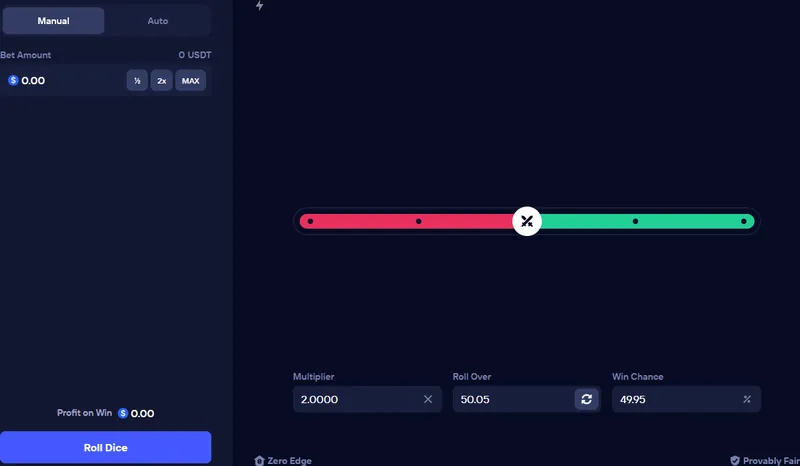
A number between 0 and 100 is generated. You set a threshold and choose whether you are betting on the result landing above it or below it. Move the threshold and the win chance moves with it, and the payout multiplier adjusts automatically to keep the maths balanced.
Setting the threshold so you win 50% of the time pays 2×. Setting it so you win 1% of the time pays 100×. There is nothing else to the game, and that austerity is the point — Dice is the cleanest possible statement of the mechanism every other casino game dresses up.
What the table proves
On a game carrying a house edge, a 50% win chance does not pay 2×. It pays something like 1.98×, and the missing 1% is the operator's revenue. The gap is small enough to be invisible in the interface and large enough to determine the outcome over any real volume.
Here every row multiplies to exactly 1.0000. A 1% chance pays exactly 100×, not 99×. That is what 100% means and Dice is the only game where you can read it directly off the paytable without doing any arithmetic yourself.
It is worth setting a threshold and checking the displayed multiplier against the inverse of the chance, once, on any casino you use. It takes ten seconds and tells you more than any review.
Why systems fail here
Dice attracts more betting systems than any other game because the numbers are so legible, and it is the game where their failure is easiest to demonstrate.
Martingale. Bet at 50%, double after each loss. Each sequence ends in a win eventually and recovers everything. The problem is that "eventually" has no bound: ten consecutive losses at 50% happens roughly once in a thousand sequences, and by then the required bet is 1,024 times the original. Table limits and bankroll arrive first, and when they do the loss is the entire run.
The expectation is unchanged — zero — but the shape is much worse. You trade a large number of small results for a small number of enormous ones, and the enormous ones are all negative.
Waiting for a streak to break. Each roll is independent. Seven results above the threshold say nothing about the eighth. This is the gambler's fallacy and no amount of tracking changes it.
High-frequency low-payout grinding. Setting 95% win chance for 1.0526× feels like a slow reliable climb, and it is — until the one loss in twenty arrives and removes twenty wins in a single roll. Expected return is the same as everything else.
The only true statement: at zero edge you are expected to finish where you started, and every setting and system merely changes how long that takes and how violently it fluctuates on the way.
The house edge, seen from the other side
Dice is useful for a purpose beyond playing it: it is the clearest lens for understanding what you are paying everywhere else.
Take a slot at 96.43%. Expressed as a Dice paytable, a 50% win chance there would pay 1.9286× instead of 2×. That is the whole of the difference between a slot and a zero-edge game, and stated that way it sounds negligible.
Now run it a thousand times at ten dollars a bet. Ten thousand dollars of turnover, and the difference between paying 2× and 1.9286× on the winning half comes to about $357. That is the 3.57% edge doing its work, and rakeback hands roughly half of it back — which is why slots at Duel behave like 98.22% rather than 96.43%.
The same exercise on double-zero roulette, at a 5.26% edge, produces a paytable that would look obviously bad if a casino ever displayed it in this form. It never does, which is rather the point of the RTP table.
Bankroll and win chance
Since no setting beats another on expectation, the only decision is how long you want the session to last — and the relationship is arithmetic rather than a matter of feel.
At a 50% win chance, runs of six or seven losses happen several times an hour and mean nothing. A bankroll of fifty units absorbs them comfortably.
At 5%, you win one bet in twenty and dry runs of sixty are entirely ordinary. Fifty units at that setting will frequently return nothing at all before the money is gone — not because anything is wrong, but because fifty units is far too few for a one-in-twenty event.
A workable rule: your bankroll in units should be several times the reciprocal of your win chance. At 5% that means several hundred units, not fifty. Choosing a low win chance with a small bankroll is not aggressive play, it is buying a lottery ticket in instalments.
Automation
Dice supports scripted and automated betting more readily than any other Original, and this is where bankrolls actually disappear. Thousands of rolls run in minutes, which does not change expected return but resolves variance far faster than a human pace would.
An auto-bet configuration that increases stake on loss is Martingale with a nicer interface, and it fails identically. Configurations that hold stake flat are fine and are simply a faster way to arrive at break-even minus whatever the variance did.
Where it fits
Dice is not the most entertaining game on the site — Crash and Mines both hold attention better. What it is, is the most transparent, and it is the game to open first if you want to satisfy yourself that the zero-edge claim is real before trusting it anywhere else.
Verification is on the provably fair page. Category comparisons are on the RTP table.