Duel7 Crash
A multiplier climbs until it busts and you cash out before it does. Zero house edge, verifiable round by round, and randomness drawn from a public beacon rather than from the casino.
EDGE
PLAYER
SOURCE
How it works
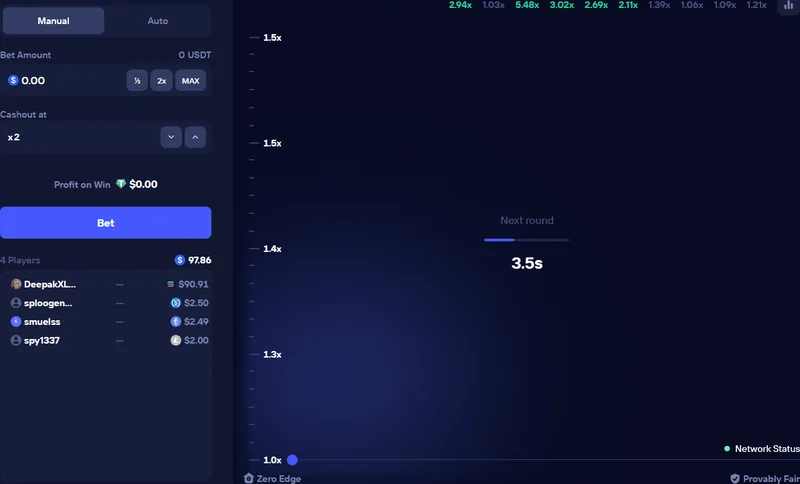
A round begins and a multiplier starts climbing from 1.00×. It rises continuously and at some unpredictable point it busts. If you cash out before that, your stake is multiplied by whatever the counter read at that moment. If you do not, the stake is gone.
That is the entire game. There is no skill in reading the curve — the bust point is fixed before the round begins and nothing that happens during it carries information. What you are choosing is a target, and the target determines your risk profile rather than your expected return.
The payout curve
| Cash-out target | Chance of reaching it |
|---|---|
| 1.10× | 90.9% |
| 1.25× | 80.0% |
| 1.50× | 66.7% |
| 2.00× | 50.0% |
| 3.00× | 33.3% |
| 5.00× | 20.0% |
| 10.0× | 10.0% |
| 50.0× | 2.00% |
| 100× | 1.00% |
At 100% RTP the win chance is simply the inverse of the target. On a game with a house edge each figure would be slightly lower, which is exactly where the edge lives.
Why the table looks like that
Multiply any row and you get the same answer. A 2.00× target with a 50% chance returns 1.00 in expectation. A 100× target at 1% returns 1.00. So does every row between them.
That is what zero house edge means in practice, and it has a consequence people find counterintuitive: there is no optimal cash-out point. Advice to "always take 1.5×" or "wait for 3×" is describing a preference about variance, not an edge. Both strategies return exactly the stake in expectation over enough rounds.
What differs is the ride. Cashing out at 1.10× wins nine times in ten and pays almost nothing, so a bankroll drifts gently. Targeting 100× loses ninety-nine rounds in a hundred, and the hundredth pays for all of them — over a short session it will usually just look like losing.
Compare this with a game carrying an edge, where every row in an equivalent table would return slightly less than the stake. That gap is the casino's revenue and it is why the RTP table is the most useful page on this site.
The drand beacon
Standard provably fair systems use a server seed the casino generates. The commitment is real — the hash is published before play and cannot be changed afterwards — but the casino did choose the value.
Crash removes even that. Its entropy comes from drand, a public randomness beacon run by a distributed group of independent organisations, publishing an unpredictable value at fixed intervals. Nobody can predict the next output and nobody can influence it, including the casino.
The practical result is that you can verify a Crash round against a source that has nothing to do with Duel. Take the beacon round for that moment, combine it with the round's seeds, and confirm the bust point independently. The walkthrough is on the provably fair page.
This is the strongest fairness claim available at any casino, and it is worth understanding that it is a genuinely different category from "audited by a testing house".
Strategies, and why none of them work
Crash attracts systems more than any other game in this category, because a rising number feels like something that can be read. It cannot.
Martingale. Double after every loss so one win recovers everything. The expectation is unchanged — it converts many small losses into one rare enormous one, and the enormous one arrives eventually. Table limits and bankroll ensure it.
Waiting for a pattern. After five low busts, a high one is not more likely. Each round draws independently from the beacon and carries no memory of the previous one. This is the gambler's fallacy with a graph attached.
Auto cash-out at a "safe" multiplier. Reasonable as a discipline device, useless as an edge. 1.10× has the same expected return as 10×.
The only true statement about strategy here is about variance: pick a target that matches how long you want the session to last, and understand that the expected outcome is break-even before the noise.
Bankroll and target selection
Since no target beats another on expectation, the only real decision is how long you want the session to last for a given deposit — and that is a variance question with a concrete answer.
At a 2.00× target you win about half your rounds. A hundred-dollar bankroll at one dollar a round survives a long time and the balance oscillates gently. Losing streaks of six or seven happen regularly and mean nothing.
At 10× you win one round in ten. The same bankroll now faces dry runs of thirty rounds with complete regularity, and a hundred rounds without a hit is unusual but entirely possible. If a hundred dollars is a hundred rounds, you may well never see a win.
The rule that follows: your bankroll in units should comfortably exceed the reciprocal of your target, several times over. Chasing 100× with fifty units is not a strategy, it is a lottery ticket with extra steps.
The auto cash-out feature is worth using even though it confers no edge, because it removes the decision from the moment of maximum adrenaline. Most bad Crash rounds are a player who intended to take 2× and did not.
Crash across the market
Crash originated in the Bitcoin gambling scene and is now near-universal, which makes it one of the few games where a direct cross-operator comparison is meaningful — same mechanic, same interface, different maths underneath.
Most implementations carry a house edge of around 1%, applied by shifting the bust distribution slightly against the player. It is invisible in the interface and shows up only in the payout table, where each row returns slightly less than the stake. Over sustained play that 1% is the whole of the difference.
Duel's runs at 100%, which means the table on this page multiplies out to exactly 1.00 rather than 0.99. Whether that difference matters depends entirely on volume: for an occasional session it is noise, and for someone playing regularly it is the single largest structural advantage available anywhere on the site.
Where it fits
Crash is the reason a lot of people open a crypto casino at all, and at zero edge it is genuinely one of the better ways to spend an evening gambling. Expected return is exactly what you stake, which no traditional casino offers on anything.
Break-even is not profit, and variance still ends sessions badly with complete regularity. What is removed is the systematic drain, not the swings — and Duel funds the arrangement from the slot catalogue and sportsbook, where the rakeback reduces an edge rather than eliminating it.