Duel7 Mines
A five-by-five grid with mines hidden in it. Reveal safe tiles to build a multiplier, cash out whenever you like, and hit a mine to lose everything staked.
| Mines | 1 tile | 3 tiles | 5 tiles |
|---|---|---|---|
| 1 | 1.04× | 1.13× | 1.24× |
| 3 | 1.13× | 1.51× | 2.06× |
| 5 | 1.25× | 2.03× | 3.46× |
| 10 | 1.67× | 4.34× | 12.9× |
| 15 | 2.50× | 13.0× | 86.6× |
| 20 | 5.00× | 69.4× | 2300× |
| 24 | 25.0× | — | — |
Multiplier after revealing the stated number of safe tiles. With 24 mines only one tile is safe, so there is no third or fifth reveal. Check the in-game paytable, which is authoritative.
How it works
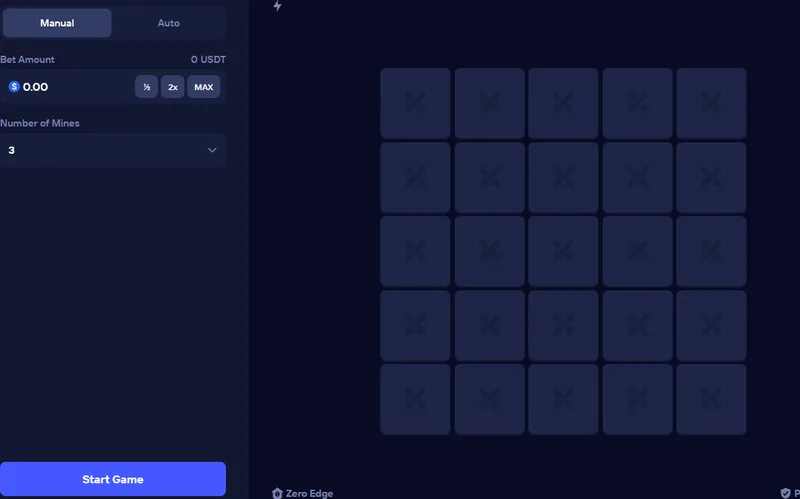
Twenty-five tiles, a number of mines you choose, and the rest safe. Each safe tile you reveal raises the multiplier. Cash out at any point and take it; hit a mine and the round ends with nothing.
The entire game is the decision of when to stop, and that decision has no correct answer. Every additional tile increases the multiplier by exactly enough to compensate for the added risk, which is what 100% RTP means. Stopping at one tile and pushing to ten have identical expected value.
Why the multipliers grow so fast
With three mines and twenty-two safe tiles, the first click is safe 88% of the time. The second, with one fewer safe tile available, is slightly riskier. By the tenth reveal the cumulative probability of having survived every click has fallen a long way, and the multiplier has to rise to match it.
At twenty mines the effect is dramatic. One safe click in five, and surviving five in a row happens roughly once in two thousand attempts — which is why the table shows 2300× there. The multiplier is not generosity, it is the inverse of a probability.
This is the same structure as Crash targets and Plinko risk levels. Every configuration of every Original returns the same amount and differs only in how the return is distributed.
The one genuine mistake
Believing a tile is safer because it is in a corner, or because the last mine was in the middle, or because a pattern seemed to be emerging. The layout is fixed by the seeds before your first click and no revealed tile carries information about any unrevealed one.
Mines feels more like a game of skill than Crash or Plinko because you are clicking specific squares. That feeling is entirely an illusion produced by the interface, and it is the reason this game holds attention better than a number that simply appears.
The arithmetic behind a row
Worth working one through, because it makes the whole structure obvious.
Take three mines. Twenty-five tiles, twenty-two safe. The first click is safe with probability 22/25, or 88%. If it survives, twenty-one of twenty-four remain safe, so the second is safe with probability 87.5%. The third is 21/23, or 86.4%.
Surviving all three is those probabilities multiplied together — about 66.5%. At 100% RTP the multiplier must be the inverse of that, which is 1.50×. The table above shows 1.51×, and the small difference is rounding in the display rather than an edge.
That relationship holds at every mine count and every depth. The multiplier is never a decision the casino made about how generous to be; it is arithmetic, and you can check any cell in the table with a calculator. On a game carrying a house edge the published multiplier would sit slightly below the inverse of the probability, and that gap would be the whole of the operator's revenue.
Auto-play and where it goes wrong
Mines supports automated rounds with a fixed number of tiles and a fixed cash-out. Expected return is unchanged, and two things about it are worth knowing.
It resolves variance far faster than manual play. A configuration that would take an hour by hand runs in minutes, so a bankroll that would have survived the evening does not. Nothing has gone wrong when that happens — the same outcomes arrived sooner.
It also removes the one part of the game that holds attention. Mines is engaging because each click is a decision, and automating it turns the game into a slot machine with extra steps. If the automated version stops being enjoyable, that is worth noticing rather than pushing through.
Mines across the market
Like Crash and Plinko, Mines is standard across crypto casinos, and most implementations run at around 99% by trimming each multiplier slightly below the inverse of its probability. The trim is invisible without doing the arithmetic, which is why almost nobody notices it.
Duel's runs at 100%, so the multipliers match the maths exactly. Over a handful of rounds that is nothing. Over the volume auto-play reaches, it is the difference between a game that grinds a balance down and one that does not, and it is the same pattern across all five Originals — funded by the slot catalogue and sportsbook where rakeback reduces an edge rather than removing it.
Choosing a setting
The honest answer is that it does not matter for return and matters entirely for experience.
Low mine counts with several reveals give a long grinding session where the balance moves slowly. High mine counts give a short one with a small chance of something large. Neither is better and both average out to break-even.
A workable habit is to fix the cash-out point before starting a round rather than deciding tile by tile. Most bad Mines rounds are someone who intended to stop at three and took a fourth because the fourth felt safe. It was not safer; it was the same risk it had been all along.
One more thing worth fixing in advance: decide the mine count before you sit down, not after a losing round. Raising the count to chase a loss is the Mines version of Martingale, and it fails the same way — a rarer, larger swing dressed up as a recovery plan.
Verification is on the provably fair page, and the full category comparison is on the RTP table.